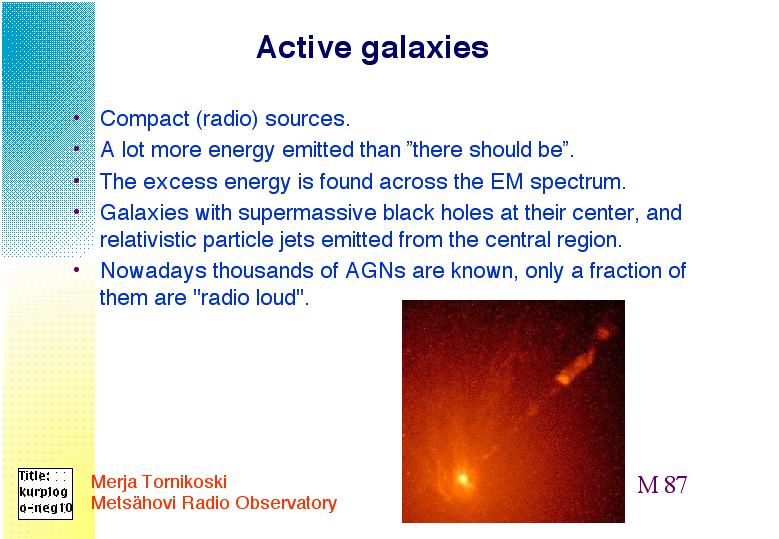
Figure:
Hubble image of M87 = 3C274. A giant elliptical galaxy in the Virgo
constellation (15 MPc, 50 mil ly). A brilliant jet of high-speed
electrons that emits from the nucleus is believed to be produced by
the black hole "engine".
Press release text at STSCI.
There are overwhelmingly numerous known AGN classes and subclasses. This lecture material focuses on the radio-loud AGNs, but even among them the naming convention is far from consistent or clear. The following list introduces some of the most important AGN classes. Some of them will be discussed in more detail in the unification section (from Slide 34 onward).
FR I radio galaxy = Fanaroff-Riley type I radio galaxy. These objects
usually have prominent smooth continuous two-sided jets running into
large-scale lobes structures which appear edge-darkened.
FR II radio galaxy = Fanaroff-Riley type II radio galaxy. These objects
tend to have edge-brightened large-scale structures with bright outer
hotspots.
The FR I / FR II division also appears in the luminosity of these sources,
with FR I sources being less luminous and FR II more luminous than
P(178MHz)=2*1026 WHz-1 (Fanaroff & Riley 1974).
QSO = "Quasi stellar radio source" or a "quasi-stellar object", quasar. These are the strong, small-diameter objects that were discovered in the 1960's. Quasars are considered to be compact active nuclei of galaxies (AGN).
HPQ = Highly polarized quasar, with the otical polarization p>3%.
LPQ = Low-polarized quasar, with the otical polarization p<3%.
OVV = Optically violently variable quasars. In general, these sources belong to the HPQ category.
FSRQ = Flat-spectrum radio-loud quasars, vs. SSRQ = Steep spectrum radio quasars. Classficiation is based on the shape of the radio continuum, with the dividing line set at alpha=-0.5 measured at a few GHz.
BLO = BL Lacertae object. (Originally radio-loud) objects with featureless continuum spectrum (very weak emission lines). They usually show strong polarization and rapid variability. The archetype BL Lacertae is a source which was first suspected of being a variable star in our Galaxy.
Blazars, "Blazing quasars", originally combined OVVs (HPQs) and BLOs to one class of objects with dramatic flares observed at several frequency domains. Now often: AGNs observed at high energies (gamma-rays).
Last update: 2001-07-24 / mtt