Synchrotron radiation = relativistic electrons, i.e. at almost the speed of light, in magnetic fields. Understanding the synchrotron mechanism is very important for understanding the structure and emission mechanisms of AGNs.
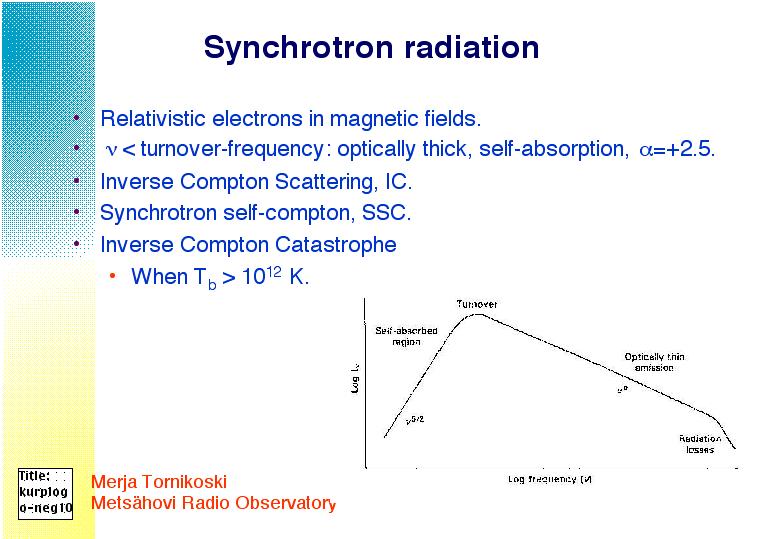
The figure shows a general synchrotron spectrum for a homogeneous source. When the observing frequency is smaller than the "turnover" frequency, the source appears optically thick due to self-absorption. The spectral index (the slope of the spectrum) is alpha=+2.5
Self-absorption: an electron absorbs a synchrotron photon emitted by another electron. The self-absorption turnover frequency depends on the source size, luminosity, geometry of the observation, etc.
alpha: the spectral index of the optically thin part of the spectrum. alpha=(1-p)/2, where p is the electron energy distribution (electron power-law energy spectrum).
The spectrum steepens due to energy losses and aging. At some point there is a high-energy cutoff: at high energies the energy loss of the electrons (radiation losses, IC mechanism) starts to have a considerable effect.
Inverse Compton Scattering, IC: Relativistic synchrotron electrons interact with photons, the photon energy is boosted to higher energies. "A source of energy for photon fields, a cooling process for electrons", as opposed to Compton scattering.
Synchrotron self-compton, SSC: IC when the scattered photons are those created by the synchrotron radiation of electrons.
Inverse Compton Catastrophe: For a source with a very high
luminosity or a very small size the IC mechanism dominates, high-energy
electrons scatter their own photons to yet higher frequencies. The source
is optically thin i.e. does not behave like a self-absorbed source,
photons escape, electrons quickly loose their energy, the source does not
remain a synchrotron source for very long.
It is possible to calculate the largest possible brightness temperature
Tb before the IC starts to dominate:
Tb=1012 K. (Note! The Tb of a
synchrotron source is not the physical temperature of the source!)
Some of the Metsähovi group's results suggest that the maximum
Tb could be even less, Tb ca. 1011 K.
Quasars with Tb greater than 1012 K are, however,
oberved -- this can be explained by relativistic effects (Doppler
boosting) (see the next two slides).
Last update: 2001-07-24 / mtt