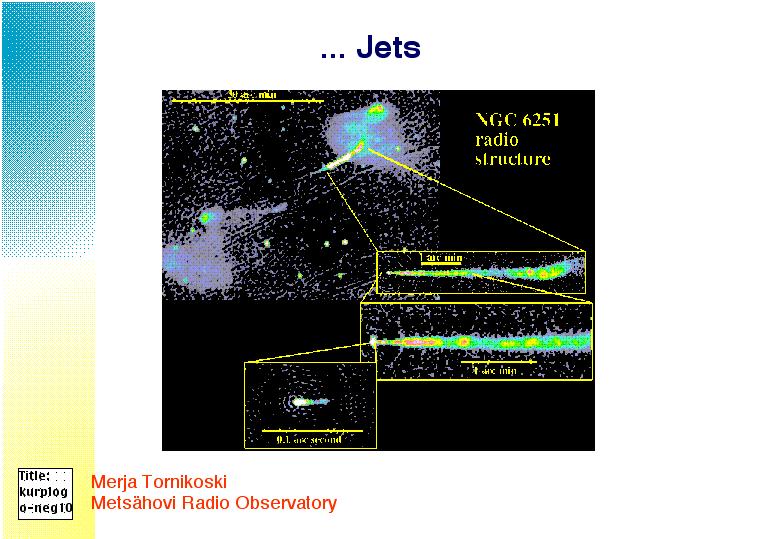
Figure copied with permission from The AGN Gallery.
Figure caption:
One important lesson from radio galaxies is that the central engine
continues to eject material in nearly the same direction for at least
several million years, based on the fact that the tiny parsec-scale
jets in the core regions point in the same direction as the very
extended radio structure which may stretch several million light-years
(and thus took at least that many years to form). The nearby radio
galaxy NGC 6251 is an excellent example. The largest structures are
seen in a map made with the Westerbork Synthesis Array Telescope in
the Netherlands, which can map somewhat larger objects than the VLA,
working in this case at a wavelength of 49 cm. This image spans almost
a full degree (56 arcminutes) east-to-west. Closing in toward the
nucleus are two maps made with the VLA at 20 centimeters wavelengths,
showing the extraordinary straight and narrow jet feeding toward the
northwest radio lobe, spanning 308 and 188 arcseconds. Finally, the
innermost core is shown in a VLBI map with a resolution of only 3
milliarcseconds (0.003 arcsecond), showing that knots are still moving
outward from the nucleus in nearly the same direction. The VLA and
VLBI maps have been rotated to make the jet horizontal for
convenience. The WSRT map shows the faint counterjet opposite the
bright jet; its weakness may indicate that the jet is in relativistic
motion more or less toward us, so that Doppler boosting makes it
appear dramatically brighter than its counterpart.
The Westerbork data were provided by Karl-Heinz Mack, as presented by Mack, U. Klein, C.P. O'Dea, and A.G. Willis 1997 A&AS 123,423. Rick Perley furnished the VLA data, and Dayton Jones made his 11-station VLBI image available.
Last update: 2001-07-24 / mtt