Figure captions:
Left:
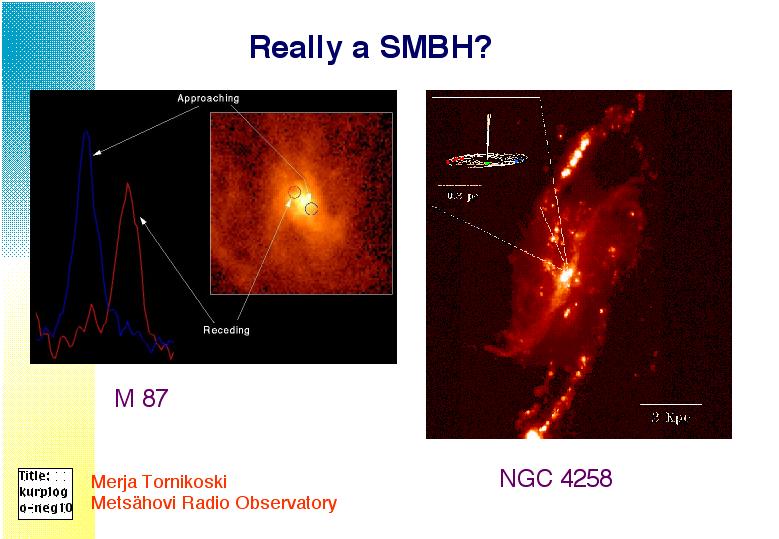
A schematic diagram of velocity measurements of a rotating disk of hot
gas in the core of active galaxy M87.
The measurement was made by studying how the light from the disk is redshifted and blueshifted -- as part of the swirling disk spins in earth's direction and the other side spins away from earth. The gas on one side of the disk is speeding away from Earth, at a speed of about 1.2 million miles per hour (550 kilometers per second). The gas on the other side of the disk is orbiting around at the same speed, but in the opposite direction, as it approaches viewerm on Earth.
This high velocity is the signature of the tremendous gravitational field at the center of M87. This is clear evidence that the region harbors a massive black hole, since it contains only a fraction of the number of stars that would be necessary to create such a powerful attraction.
A black hole is an object that is so massive yet compact nothing can escape its gravitational pull, not even light. The object at the center of M87 fits that description. It weights as much as three billion suns, but is concentrated into a space no larger than our solar system.
Credit: Holland Ford, Space Telescope Science Institute/Johns Hopkins University; Richard Harms, Applied Research Corp.; Zlatan Tsvetanov, Arthur Davidsen, and Gerard Kriss at Johns Hopkins; Ralph Bohlin and George Hartig at Space Telescope Science Institute; Linda Dressel and Ajay K. Kochhar at Applied Research Corp. in Landover, Md.; Bruce Margon from the University of Washington in Seattle; and NASA.
Right:
Some of the best evidence for black holes comes from
observations of maser emissions (coherent microwave radiation
analogous to laser light) from a dusty torus near the center of an AGN
called NGC 4258. From the speed of the dust (about 900 km/sec)
rotating around the galactic center, astronomers have calculated that
the central gravitating body has a mass of almost 40 million Suns, all
within a radius less than 0.05 light years. This works out to a
density of 50 million solar masses per square light year, a density
some 5,000 times greater than that of any known cluster of stars. The
high-resolution pictures of the heart of NGC 4258 were made with the
Very Long Baseline Array, a network of radio telescopes located from
Hawaii to the Virgin Islands.
The press
release text at NRAO.
Last update: 2001-07-24 / mtt