ASTROPHYSICAL MASERS
The 22 GHz water maser line is the brightest spectral line in the radio universe and highlights shocked star forming regions, dense circumstellar shells around evolved stars as well as circumnuclear disks around black holes of galactic nuclei. Most interestingly, this for life very important H2O molecule
is copiously produced already during the birth process of a star
via the powerful shocks associated with the star formation
process. The birth of a massive star generates strong stellar
winds (with velocities up to a few thousand km/s), which shock
the ambient cloud material. Shocks with velocities exceeding some
20 km/s running into high-density magnetized material
successfully explain the water maser emission (Hollenbach & McKee
1989; Elitzur, Hollenbach & McKee 1989). The shocked gas has both
the high temperature and density required for the water molecule
production and for the collisional excitation of the maser
levels.
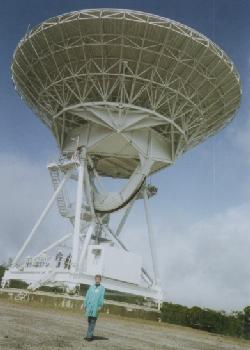
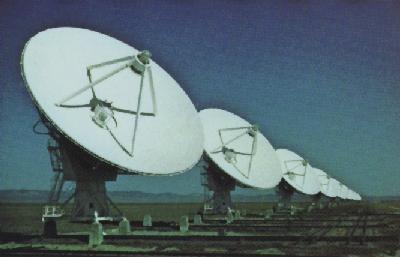
The first 22 GHz linear-polarization sensitive Very Long
Baseline Interferometry (VLBI) images of low-velocity water
masers in the star forming region W51 M were obtained with the
Very Long Baseline Array (VLBA) of NRAO (USA) using the new
calibration technique developed by K. Leppänen (1995, Thesis,
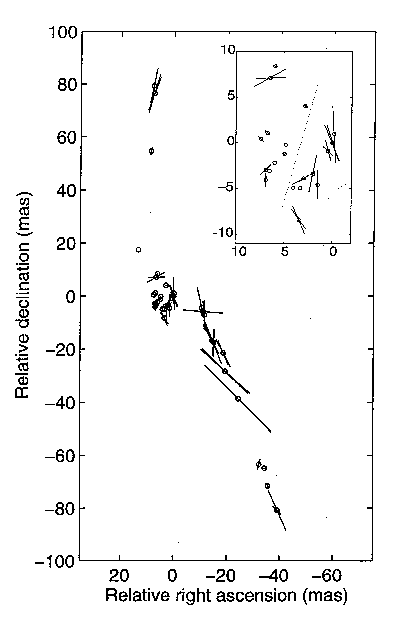
Helsinki Univ. of Technology). These 2-epoch VLBA observations
revealed two distinct features: (1) a compact, slightly elongated
water maser concentration near the reference position (0,0), and
(2) a NNE-SSW oriented 1200 AU long structure of masers, which is
roughly aligned along the large-scale galactic magnetic field and
the direction of the polarization vectors of these masers (Fig.
a). The compact maser concentration at the reference position is
identified as a protostellar cocoon with both rotational and
radial motions. The inner and outer radii of this maser cocoon
are 5 AU and 66 AU, respectively. In contrast to the cocoon
masers, which show a mean linear polarization of only 3%, the
masers in the large-scale structure show higher degrees of linear
polarization (mean 12%, maximum 35%).
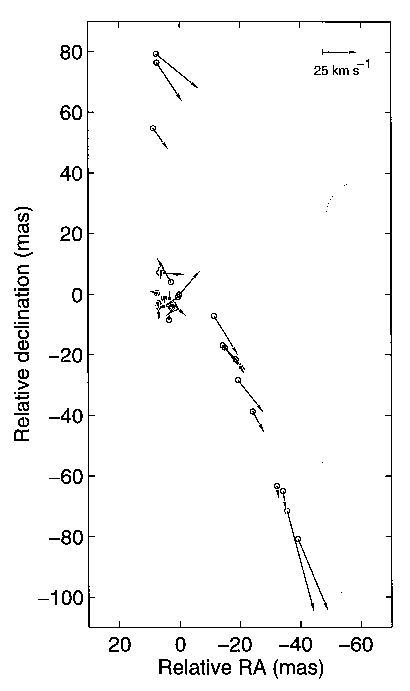
The proper motions (Fig. b), obtained from the two observing epochs, indicate that the masers in the large-scale structure move longitudinally with a median space velocity of 25 km/s relative to the protostar. This streamer cannot be explained as a bipolar outflow from the protostar. Most likely the maser stream is produced by shocks, caused by the nearby expanding HII region, which interacts with the dense molecular core of W51 M on its western side. The proximity to the protostar suggests that these shocks have affected, or even triggered, the star formation in W51 M. More details of this study can be found in Leppänen, Liljeström, & Diamond, (1998, ApJ, 507, 909-918). These first spectral line VLBI polarization observations of 22
GHz water masers have shown that VLBI polarimetry provides an
effective tool for probing large scale magnetic field structures
in very dense star forming regions. Therefore, we have extended
our maser polarization observations (using VLBA) to a few other
well-known water maser sources (Liljeström et al., in
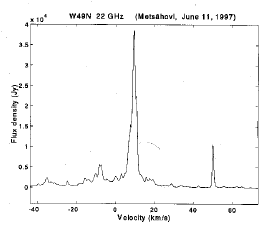
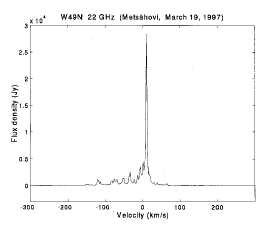
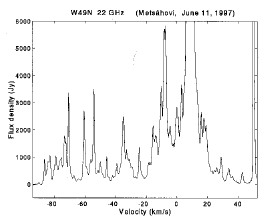
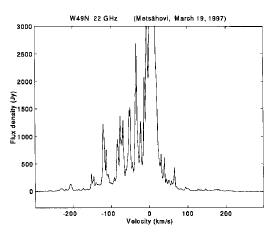
preparation). The Metsähovi radio telescope has been used for a long-term monitoring program of the 22 GHz water maser line. One of our main targets has been W49 N, the most powerful and populous water maser cluster in our Galaxy.
Water maser observations commonly show dramatic variations in flux density as function of time. Such short-lived (typically some 2 months) increases in flux density are termed as "outbursts". Combining the Metsähovi database of some 150 maser outbursts ( Liljeström 2000, Journal of Astron. Data, 6, 2) with simultaneously obtained VLBI data of W49 N (Gwinn 1994), notably obtained with the same velocity resolution, Liljeström & Gwinn (2000, ApJ, 354, 781-800) succeeded to fix the free parameters in the shock model of Hollenbach & McKee (1989) and the maser model of Elitzur, Hollenbach & McKee (1989). This enabled a straightforward determination of some 20 physical parameters of W49 N. The most important characteristic of the novel diagnostic
method of Liljeström & Gwinn (2000) is its capability to
determine both preshock and postshock magnetic field strengths in
dense, shocked regions, as well as the inclination angle of the
mean field with respect to the line of sight. The crucial
observation is the measurement of the nonthermal velocity
variation of the line peak during maser outbursts. These velocity
fluctuations are caused by Alfvenic wave pressure, which is
substantially increased in the sudden compressions associated
with shocks. The fact that Alfvenic wave fluctuations are
oriented perpendicular to the magnetic field lines, enabled us to
estimate the inclination of the mean magnetic field from the
observed dispersion of the Doppler velocity fluctuations (see
Liljeström & Gwinn 2000, ApJ, 354, 781-800). A 96 GHz water maser survey programme, carried out towards
protostars and late-type stars, yielded the first discovery of
vibrationally excited water masers in two protostars. The maser
line velocities were close to the stellar velocity (or slightly
redshifted). Because the upper energy level of this vibrationally
excited line at 96 GHz is 3065 K, it is very likely that this
maser line originates within a few stellar radii from the central
protstar in the inner edge of the circumstellar envelope. In this
region the density and radiation field are yet sufficiently low
to allow nonthermal maser emission. Also the dust (which promotes
the outward expansion of the envelope) has not yet formed. Fore
more details, see Liljeström, Winnberg, & Booth (in P. Piironen,
A. Räisänen (eds.), URSI/IEEE/IRC XXI Convention on Radio
Science, Helsinki Univ. of Technology, Radio Laboratory Report,
Vol. S 222 (Espoo 1996), p. 96.
|